Published: 30 October 2026
The Budget makes no mention of public investment to halt the decline in the condition of Britain’s vital network of rivers and canals.
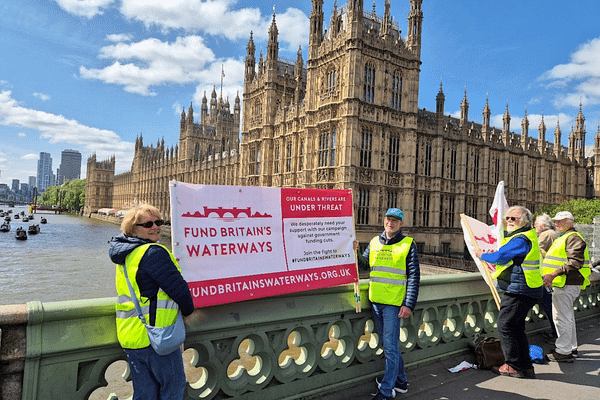
In recent years, the coalition group Fund Britain’s Waterways (FBW) has made representations to the Treasury, drawing attention to the many benefits that Britain’s canals and rivers provide. It has been demonstrated repeatedly that underinvestment in the waterway network is a false economy; lack of maintenance results in catastrophic failures which can cost millions of pounds to rectify. But analysis of the return on investment provided by the network shows that it can return billions of pounds in health, economic and environmental benefits.
For the second year in succession, prolonged drought conditions during the summer months of 2026 led to the closure of many parts of the canal and river network, with severe consequences for waterway users and the businesses which depend upon them.
The Chancellor, John Healey, said that the 2026 Autumn Budget is “for the working people of Britain. It’s a Budget for business, big and small” which is “built on fiscal discipline”. Many waterway businesses are on a modest scale, and they will at least welcome the Chancellor’s announcement of an increase in the small business rate relief threshold, which will result in some leisure businesses paying no business rates.
The Chancellor’s emphasis on devolution also gives reasons for guarded optimism. Published alongside the Budget, the Fiscal Devolution Roadmap outlines a structural reform of local and regional government finance in England, shifting power away from central Whitehall grants toward locally retained tax revenues. The FBW Campaign hopes that the new Strategic Authorities (enabled by the English Devolution and Community Empowerment Act 2026) will use their new powers ‘to handle orders and functions concerning inland waterways’ imaginatively in support of their local rivers and canals. The Strategic Authorities will also have responsibility for environmental management and climate resilience; these are issues whose effects are felt locally, and especially by waterway users.
Hazel Owen, Fund Britain’s Waterways Campaign Chair, said:
“The real test of the Budget is what it delivers for our rivers and canals. Flood protection matters, but it is not a substitute for reliable waterways maintenance. We need clear, long-term funding and measurable results that keep waterways safe and accessible, improve water quality, and protect habitats.”
References
The benefits of Britain’s inland waterways are documented in:
1. The latest British Marine Economic Benefits report (April 2024) which includes:
The combined economic contribution of the inland boating sector and its wider associated tourism generated the UK was £7.6bn in total for the year 2022/23 (the figure includes £1.6bn from the inland marine industry plus £6bn from wider tourism generated by expenditure of those participating in inland boating and other inland watersports on non-boating goods and services such as food and hospitality)
Employment – the inland marine industry provides 41,166 total jobs. In addition, wider tourism associated with inland boating provides 295,886 jobs, so not only does inland boating directly employ over 41,000 people but it also supports almost a further 300,000 jobs through its associated wider tourism.
2. ‘Waterways for Today’ report published by the Inland Waterways Association (November 2022)
3. ‘Valuing Our Waterways’ report published by the Canal & River Trust with social value experts Simetrica-Jacobs, with all methodology aligning with 2022 HM Treasury Green Book valuation techniques (November 2022)